Gambling Laws in the UK
- Updated Jul 17, 2026: Full legal review: 2025/26 reforms added (stake limits, statutory levy, deposit-limit rules, Budget tax changes), plus FAQ and updated references.
- Updated May 30, 2025: First version of the page published.
The UK has some of the strictest gambling laws in the world. The UK Gambling Commission (UKGC) oversees all gambling activities under the Gambling Act 2005, from land-based casinos and betting shops to lotteries and online gaming. Since 2023 the rulebook has been changing faster than at any point in two decades, with stake limits, a statutory levy and major tax rises all now in force. This guide covers the current legislation and what it means for you as a player.
UK Gambling Laws at a Glance
| Regulator | UK Gambling Commission (UKGC) |
| Principal law | Gambling Act 2005, extended by the Gambling (Licensing and Advertising) Act 2014 1 |
| Legal gambling age | 18 for all forms of gambling; 16 permitted only to sell National Lottery products, not to play |
| Online slot stake caps | £5 per spin (age 25+), £2 per spin (age 18 to 24) |
| Tax on player winnings | None. Winnings are tax free for players; operators pay gambling duties instead |
| Self-exclusion | GAMSTOP, free and mandatory for all UKGC-licensed online operators |
| Support services | GambleAware, GamCare, National Gambling Helpline (0808 8020 133, 24/7) |
- United Kingdom Gambling Commission Keeping gambling fair and safe for all
- GambleAware Promoting and supporting responsible gambling
- eCOGRA Testing online gambling safety and fairness since 2003
Legal vs. Illegal Forms of Gambling in the UK
Gambling is legal in the UK, both online and in person, provided the operator holds the right licence. Unlicensed or unauthorised operations are a criminal offence. Every operator ranked on our UK casino hub holds a UKGC licence, which is the single most important legality check a player can make.
Legal forms of gambling include:
- Online gambling: Casino games, poker, slots, betting, and bingo
- Land-based casinos: Licensed and regulated by local authorities and the UKGC
- Sports betting: In-person and online sportsbooks
- Lotteries and raffles: The National Lottery and society lotteries
- Gaming machines: Permitted in licensed premises
Prohibited or illegal gambling includes:
- Operating without a UKGC licence
- Offering gambling services to UK players from offshore without authorisation
- Betting by individuals under the age of 18
- Unlicensed private lotteries or non-compliant prize draws
Casino Gambling Laws
Casino gambling is permitted online and in land-based venues, provided the operator is licensed by the UKGC.
Land-based casinos:
- Must obtain approval from local licensing authorities and remain subject to strict oversight on premises, game fairness, security, and staff licensing
- Since 22 July 2025, converted casinos (venues licensed under the older 1968 Act rules) may install up to 80 gaming machines on a size-based sliding scale, and may offer sports betting on site 8
Online casinos:
- Must hold a remote operating licence from the UKGC
- Required to implement technical standards, player protections, and anti-money laundering measures
- Must participate in GAMSTOP for self-exclusion services
- Must apply the online slot stake caps of £5 per spin for players 25 and over, and £2 for players aged 18 to 24 5
Sports Betting Gambling Laws
Sports betting is legal and well-regulated in the UK, both in physical betting shops and through online platforms.
Land-based betting shops:
- Licensed under the Gambling Act 2005, often in high street locations
- Can offer fixed-odds betting terminals, with stakes capped at £2 since April 2019
Online sports betting:
- Requires a remote betting licence
- Operators must display clear terms, verify customer identity, and run financial vulnerability checks
- In-play and spread betting are allowed but must be tracked and offered under transparent terms
Bingo and Lotteries
Bingo and lotteries are legal under UK law, with specific licences depending on scale and type.
Bingo:
- Land-based bingo halls require an operating licence and local authority approval
- Online bingo operators must be licensed and compliant with remote gambling standards
Lotteries:
- The National Lottery is regulated under separate legislation (the National Lottery etc. Act 1993) 3
- Private, society, and local authority lotteries are allowed under conditions that prevent profit-driven commercial use
Gambling Authority: UK Gambling Commission
The UK Gambling Commission (UKGC) is the official regulatory body overseeing gambling in Great Britain. It monitors that all activities are conducted fairly, openly, and free from crime while protecting children and vulnerable players. The UKGC licenses and regulates gambling operators, enforces the Licence Conditions and Codes of Practice (LCCP), and since 2025 also administers the statutory levy that funds research, prevention and treatment of gambling harm.
Key facts about the UK Gambling Commission:
| Founded | 2005 (under the Gambling Act 2005) |
| Headquarters | Birmingham, England |
| Jurisdiction | Great Britain (Northern Ireland has separate legislation) |
| Key roles | Licensing, compliance, enforcement, player protection, levy administration |
| Website | https://www.gamblingcommission.gov.uk |
How to Check if a Casino Is Licensed
Every licensed operator has an entry on the UKGC public register, and checking it takes under a minute:
- Scroll to the footer of the casino site and note the operator company name and licence number.
- Open the UKGC’s public register of licensees.
- Search the UKGC register by operator name or licence number.
- Confirm the licence status is active and that the domain you are playing on is listed against it.
Legal Gambling Age in the UK
In the UK, the general legal gambling age is 18. This applies to all forms of gambling, both online and land-based, including the National Lottery and scratchcards, which moved from 16 to 18 in 2021.
Minimum legal age by gambling activity:
| Gambling Activity | Minimum Age |
|---|---|
| Betting (online and in shops) | 18 |
| Casino games (online or in-person) | 18 |
| Bingo (online or in halls) | 18 |
| Slot machines (except low stakes) | 18 |
| National Lottery | 18 |
| Scratchcards | 18 |
| Private or prize lotteries | 18 |
Exceptions and special provisions:
- Sales by minors: If authorised by the business operator, individuals aged 16 and over may sell National Lottery tickets and scratchcards
- There are no forms of legal gambling under 16; parental permission does not override these laws
Retailers and operators must confirm a customer is over the minimum gambling age before providing access to any gambling product. Enforcement includes test purchasing schemes and penalties for non-compliance. 4
Legal Timeline of Major Gambling Laws in the UK
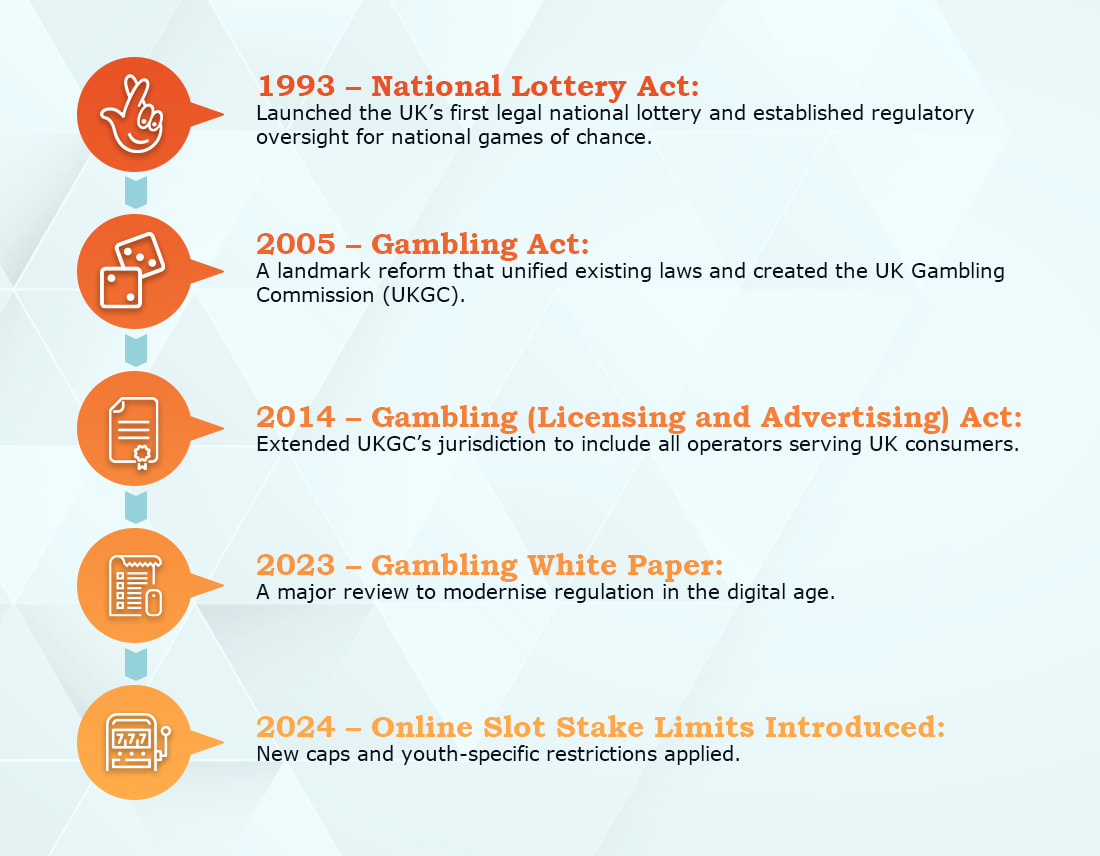
British gambling legislation has been rewritten several times since 1960, usually when technology outgrew the old rules. These are the milestones that still shape gambling policy and oversight today.
| Year | Milestone | What changed |
|---|---|---|
| 1960 | Betting and Gaming Act | Legalised betting shops and members’ gaming clubs, the first modern licensing framework |
| 1968 | Gaming Act | Created the Gaming Board and the casino licensing regime that “converted” venues still trace back to |
| 1993 | National Lottery Act | Launched the UK’s first legal national lottery with its own regulatory oversight |
| 2005 | Gambling Act | Landmark reform that unified existing laws and created the UK Gambling Commission |
| 2014 | Gambling (Licensing and Advertising) Act | Extended UKGC jurisdiction to every operator serving UK consumers, wherever based |
| 2019 | FOBT stake cut | Maximum stake on fixed-odds betting terminals reduced from £100 to £2 |
| 2020 | Credit card ban and mandatory GAMSTOP | Gambling with credit cards prohibited; all online operators required to join GAMSTOP |
| 2023 | Gambling White Paper | “High stakes: gambling reform for the digital age” set the blueprint for modernising regulation 2 |
| 2025 | White Paper measures in force | Online slot stake limits, the statutory levy, deposit-limit prompts, and land-based casino reforms all took effect |
| 2026 | Tax overhaul begins | Remote Gaming Duty rose from 21% to 40% on 1 April 2026; bingo duty abolished 7 |
The 2023 to 2026 Reforms: What Is Now in Force
The 2023 White Paper triggered the biggest round of gambling law changes since the Gambling Act 2005. Most of its headline measures have now moved from proposal to law.
Measures already in force:
- Online slot stake limits: £5 per spin for players 25 and over (from 9 April 2025) and £2 per spin for 18 to 24 year olds (from 21 May 2025) 5
- Statutory levy: All licensed operators pay a levy of up to 1.1% of gross gambling yield, ringfenced for research, prevention and treatment; it raised close to £120 million in its first year 6
- Financial vulnerability checks: Frictionless checks apply once a customer’s net deposits exceed £150 in a rolling 30-day period 9
- Deposit-limit prompts: Since 31 October 2025, every operator must prompt new customers to set a financial limit before their first deposit, and unprotected customer funds trigger a reminder every six months 10
- Bonus rules: Since 19 December 2025, wagering requirements on bonuses are capped at 10x and mixed-product promotions are banned
- Land-based reforms: Converted casinos may operate up to 80 gaming machines and offer sports betting (from 22 July 2025) 8
Still in the pipeline:
- Gambling ombudsman: Proposed in the White Paper but not yet operational; disputes currently go through ADR providers such as IBAS, and the government has said it will legislate if the industry-led approach fails
- Deposit limits phase two: From 30 September 2026, operators must offer gross deposit limits over fixed time frames
- Remote betting duty: A new 25% rate for online betting arrives in April 2027, with horserace betting staying at 15% 7
- Adult gaming centres: Reform of the 80/20 machine ratio rule is paused pending further review
Licensing Requirements
To legally offer gambling services in the UK, operators must obtain licences from the UK Gambling Commission. Businesses must meet high standards of integrity, fairness, player protection, and financial transparency. Separate licences cover software suppliers and the key individuals who run the business.
Types of UKGC gambling licences:
| Licence Type | Purpose |
|---|---|
| Operating Licence | Required for companies offering gambling services (online or land-based) |
| Remote Gambling Licence | Specifically for online operators providing services to UK players |
| Personal Management Licence (PML) | Mandatory for key individuals responsible for strategy, finances, compliance, or operations |
| Software Supplier Licence | Needed for businesses developing and supplying gambling software |
| Betting Intermediary Licence | Required for operators facilitating betting between players (e.g., exchanges) |
Key licensing conditions include:
- Demonstrating financial stability and integrity
- Compliance with responsible gambling protocols
- Implementation of age verification systems
- Data protection and secure player fund segregation
- Transparent marketing and fair game design
Operators found to be in breach of licensing conditions risk suspension or revocation of their permit, heavy fines, and public sanctions by the UKGC.
Player Protections and Responsible Gambling
UK gambling laws include strict measures to protect players and encourage responsible gambling. Every licensed operator is legally required to provide them.
Key consumer safety measures:
- Age verification: All operators must verify that players are 18 or older before allowing deposits or play 4
- Self-exclusion: GAMSTOP lets players exclude themselves from all UKGC-licensed gambling sites in one step, for six months, one year, or five years 11
- Deposit and time limits: Players must be prompted to set a deposit limit before their first deposit, and can review or change it at any time
- Reality checks: Notifications alert players to how long they have been playing
- Cooling-off periods: Temporary time-outs and long-term account suspensions on request
Affordability and financial checks:
- Light-touch financial vulnerability checks run when net deposits pass £150 in a rolling 30 days, screening for bankruptcy orders and similar public markers 9
- Operators must monitor transactions and step in on clear signs of harm, and may request income documentation in higher-risk cases
Help and support services:
- GAMSTOP: National online self-exclusion scheme, free at gamstop.co.uk
- GamCare: Advice and free treatment services, including the National Gambling Helpline on 0808 8020 133 (24/7)
- GambleAware: Education, self-help tools, and links to support networks
- NHS gambling harm services: Specialist clinics funded through the statutory levy

Gambling Tax in the UK
Players in the UK pay no gambling tax on winnings, one of the few places in the world where that is still true. The tax burden falls entirely on operators, and it is rising sharply: the November 2025 Budget announced the biggest overhaul of gambling duties in a generation. 7
| Duty | Rate |
|---|---|
| Tax on player winnings | None |
| Remote Gaming Duty (online casino and slots) | 40% of operator profits from 1 April 2026 (previously 21%) |
| General Betting Duty | 15%; a separate 25% remote betting rate arrives in April 2027, with horserace betting staying at 15% |
| Bingo Duty | Abolished from 1 April 2026 (previously 10%) |
| Statutory levy | Up to 1.1% of gross gambling yield for online operators, scaled down to 0.1% for lower-risk sectors 6 |
Operators must also:
- Report gambling revenues to HMRC 12
- Fulfil anti-money laundering (AML) and know your customer (KYC) obligations
- Monitor financial transactions for suspicious activity
- Submit regular audits and data reports to the UKGC
Gambling Advertising Regulations
Gambling advertising in the UK is subject to strict regulation to protect vulnerable audiences, including minors, and to keep marketing honest. The rules are enforced jointly by the UK Gambling Commission, the Advertising Standards Authority (ASA), and the Committees of Advertising Practice (CAP and BCAP).
Core advertising rules include:
- No appeal to under-18s: Since October 2022, ads must not be of “strong appeal” to children, which removed footballers and celebrities popular with young audiences from gambling marketing
- Promotion of responsible gambling: All advertisements must include safer gambling messaging and support resources
- No false or misleading claims: Offers, bonuses, and returns must be presented clearly with accurate terms
- Bonus transparency: Wagering requirements are capped at 10x and mixed-product promotions are banned since December 2025
- Affiliate responsibility: Operators are held accountable for the advertising content distributed by affiliates
Recent changes:
- Premier League clubs have withdrawn gambling sponsorship from the front of matchday shirts from the 2026/27 season
- Tighter scrutiny of social media advertising and influencer partnerships
- Customers must now be able to opt in to marketing by product and channel, rather than receiving blanket promotions
Affiliate Compliance
Affiliate sites introduce players to gambling operators and must meet the same compliance standards as the operators they promote. The UKGC holds operators accountable for any breaches committed by their affiliates.
Key affiliate compliance requirements include:
- Clear and accurate presentation of bonus offers and terms
- Avoiding misleading marketing tactics or unrealistic claims
- Not targeting individuals under the age of 18 or vulnerable audiences
- Including responsible gambling messages in all marketing materials
- Operating in accordance with the CAP Code and ASA guidelines
Operator responsibility for affiliates:
- Regular monitoring and auditing of affiliate content
- Providing affiliates with up-to-date compliance guidance
- Terminating relationships with non-compliant partners
Non-compliance by affiliates can lead to fines, reputational damage, or licence reviews for the operator. As an affiliate ourselves, we hold every page on this site to those standards.
Offshore and Unlicensed Casinos
Under UK law, offering gambling to UK players without a UKGC licence is a criminal offence. Offshore sites that dodge the licensing regime lack the safeguards, consumer protections, and regulatory oversight that licensed operators must provide, and the black market has grown as regulation has tightened, so it is worth the minute it takes to check the register before you deposit.
Risks of using unlicensed or offshore casinos:
- No legal recourse or dispute resolution in case of unfair treatment or fraud
- None of the mandatory protections: no GAMSTOP, no stake limits, no deposit-limit prompts, no affordability safeguards
- Player funds may not be protected or segregated
- Increased exposure to scams, misleading promotions, and identity theft
- No guaranteed fairness or transparency of games and odds
UKGC enforcement against illegal operators:
- Blocking access to unlicensed domains in the UK
- Imposing financial penalties on affiliates promoting illegal sites
- Criminal prosecution or asset seizure for repeat or severe breaches
- Public listing and naming of banned operators
Always verify a site on the UKGC register before depositing. Every casino in our UK casino rankings is licence-checked as part of our review process, so the list is a safe starting point.
Penalties for Non-Compliance
The UK Gambling Commission has broad powers to enforce gambling laws and monitor operator compliance. Penalties range from financial fines to criminal prosecution, and they apply to operators, affiliates, and marketing partners alike.
| Violation | Penalty |
|---|---|
| No licence | Fines, prosecution, service bans |
| Ad breaches | Fines, bans, public reprimands |
| Player harm (e.g., affordability failures) | Licence suspension or revocation |
| Affiliate misconduct | Operator fines, affiliate bans |
| Misleading promotions | ASA sanctions, forced takedowns, operator accountability |
Enforcement in practice: the UKGC’s record settlement remains the £19.2 million paid by William Hill Group in 2023 for social responsibility and anti-money laundering failures, ahead of Entain’s £17 million in 2022 and 888’s £9.4 million the same year. Regulatory action is published openly, and repeat offenders face escalating consequences up to licence loss.
UK Gambling Laws FAQ
Is online gambling legal in the UK?
Yes. Online casino games, slots, poker, bingo, and sports betting are all legal, provided the operator holds a UK Gambling Commission licence. Playing at an unlicensed site is not a criminal offence for the player, but it removes every legal protection you would otherwise have.
Do I pay tax on my gambling winnings?
No. Gambling winnings are completely tax free for UK players, whether from a £10 slot win or a lottery jackpot. Operators pay gambling duties instead, including the 40% Remote Gaming Duty introduced in April 2026.
What are the current online slot stake limits?
£5 per spin if you are 25 or older, and £2 per spin if you are aged 18 to 24. The caps apply to online slots only, not to table games such as roulette or blackjack.
What is GAMSTOP?
GAMSTOP is the free national self-exclusion scheme. One registration blocks your accounts across every UKGC-licensed gambling site for your chosen period of six months, one year, or five years. Membership of GAMSTOP is mandatory for all licensed online operators.
How do I know if a casino is licensed in the UK?
Check the operator name or licence number from the site footer against the UKGC public register. Licensed sites must display their licence details. The register also shows enforcement history and which domains a licence covers.
Who do I complain to about a UK casino?
Complain to the operator first. If the dispute is not resolved within eight weeks, escalate it to the operator’s ADR provider, such as IBAS. Regulatory breaches can be reported directly to the UKGC. A dedicated gambling ombudsman was proposed in the 2023 White Paper but is not yet operational.
Summary
UK gambling regulation is among the most mature and heavily enforced in the world, and it is still tightening. The Gambling Act 2005 and the UKGC remain the foundation, while the 2023 White Paper reforms have delivered stake limits, a statutory levy, deposit-limit prompts, and tougher bonus rules, with more to come through 2027.
- All gambling requires a UKGC licence; only licensed operators are legal
- The legal gambling age is 18 with no exceptions for play
- Players keep 100% of their winnings; operators carry the tax burden
- Online slots are capped at £5 per spin (£2 for under-25s)
- GAMSTOP, deposit limits, and financial vulnerability checks protect players at every licensed site
- Advertisers and affiliates face strict compliance rules with real enforcement behind them
References
- Gambling Act 2005: https://www.legislation.gov.uk/ukpga/2005/19/contents
- Gambling White Paper 2023, “High stakes: gambling reform for the digital age”: https://www.gov.uk/government/publications/high-stakes-gambling-reform-for-the-digital-age
- National Lottery etc. Act 1993: https://www.legislation.gov.uk/ukpga/1993/39/contents
- UKGC, Age and ID verification: https://www.gamblingcommission.gov.uk/public-and-players/guide/age-and-id-verification
- GOV.UK, New £2 maximum stake for under 25s playing online slots: https://www.gov.uk/government/news/new-2-maximum-stake-for-under-25s-playing-online-slots
- The Gambling Levy Regulations 2025: https://www.legislation.gov.uk/ukdsi/2025/9780348266924
- GOV.UK, Changes to Gambling Duties (Autumn Budget 2025): https://www.gov.uk/government/publications/changes-to-gambling-duties
- UKGC, Non-Remote Casino Sector legislative changes guidance: https://www.gamblingcommission.gov.uk/licensees-and-businesses/guide/non-remote-casino-sector-legislative-changes-guidance
- UKGC, LCCP Condition 3.4.4, Financial vulnerability check: https://www.gamblingcommission.gov.uk/licensees-and-businesses/lccp/condition/3-4-4-financial-vulnerability-check
- UKGC, New rules empowering consumers and boosting operator transparency: https://www.gamblingcommission.gov.uk/news/article/new-rules-empowering-consumers-and-boosting-operator-transparency
- GAMSTOP: https://www.gamstop.co.uk/
- HMRC, General Betting Duty, Pool Betting Duty and Remote Gaming Duty: https://www.gov.uk/guidance/general-betting-duty-pool-betting-duty-and-remote-gaming-duty

Katya leads product at Casino.net and has followed UK gambling regulation since the run-up to the 2023 White Paper. She maintains this guide, tracking every UKGC consultation, LCCP change, and Budget announcement so the legal picture on this page stays current for players.