Casino Self-Exclusion: How Long Can You Lock Yourself Out?
The Casino.net operator database holds responsible-gambling records for 540 casino brands across 64 markets. 903 of those listings record a self-exclusion tool. Only 409 record how long it lasts.
540
brands recorded
64
markets covered
903
exclusion listings
45%
record a length
21 y
longest found
- Edition 01
- Data snapshot 5 October 2026
- Sample 540 brands, 64 markets
- Source Casino.net operator database

 Author Casino.net Research Team
- Every figure here is frozen at the snapshot date. Any later correction is dated on this page. Later editions carry their own date and their own numbers. This study describes what the database records, not how well a tool works. If gambling is causing you harm, help is free and available now through Gambling Therapy.
More than half stop at the word “yes”
A player needs to know how long a self-exclusion lasts before using it.
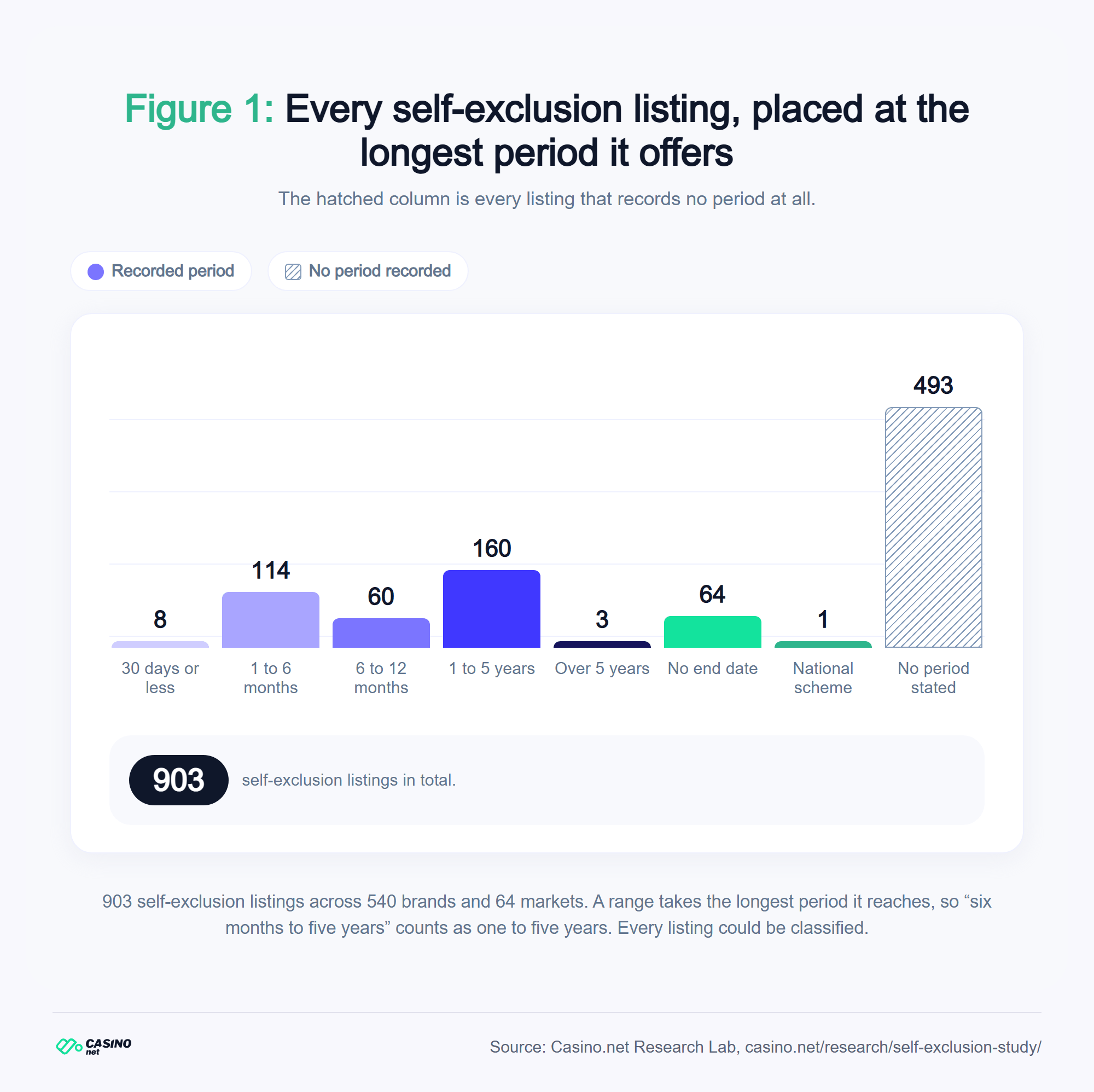
We normalised every self-exclusion value in the database into a fixed set of duration bands, taking the longest period each listing reaches. 493 of the 903 listings record that the tool exists and no period.
Figure 1: Every self-exclusion listing, placed at the longest period it offers
Snapshot 5 Oct 2026Select a band to see what sits inside it. The hatched column is every listing that records no period at all.
self-exclusion listings in total. Select a band to see what sits inside it.
409 of 903 listings record a self-exclusion period of 1 day or more. The other 494 either stop shorter or state no period.
903 self-exclusion listings across 540 brands and 64 markets. A range takes the longest period it reaches, so “six months to five years” counts as one to five years. Every listing could be classified.
How recorded disclosure differs between markets
Pick any two markets and compare what their listings record.
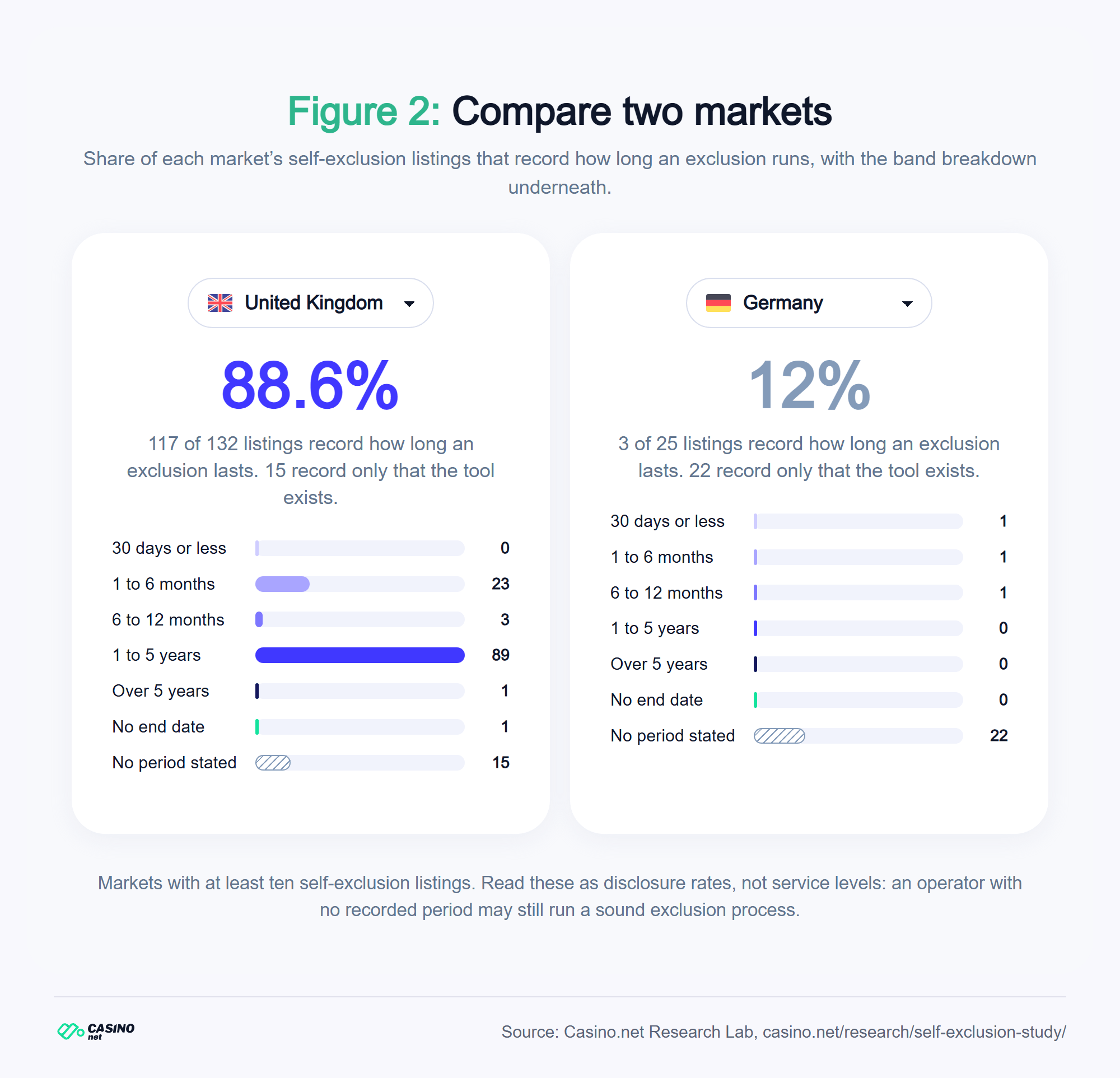
Figure 2: Compare two markets
Snapshot 5 Oct 2026Share of each market’s self-exclusion listings that record how long an exclusion runs, with the band breakdown underneath.

88.6%
117 of 132 listings record how long an exclusion lasts. 15 record only that the tool exists.

12%
3 of 25 listings record how long an exclusion lasts. 22 record only that the tool exists.
Markets with at least ten self-exclusion listings. Read these as disclosure rates, not service levels: an operator with no recorded period may still run a sound exclusion process.
Great Britain records the highest rate: 117 of 132 British listings state a period. The Gambling Commission expects licensees to offer self-exclusion of at least six months, under ordinary code 3.5.4 of the Licence Conditions and Codes of Practice. 78 of the 132 British listings describe the same window: six months to five years.
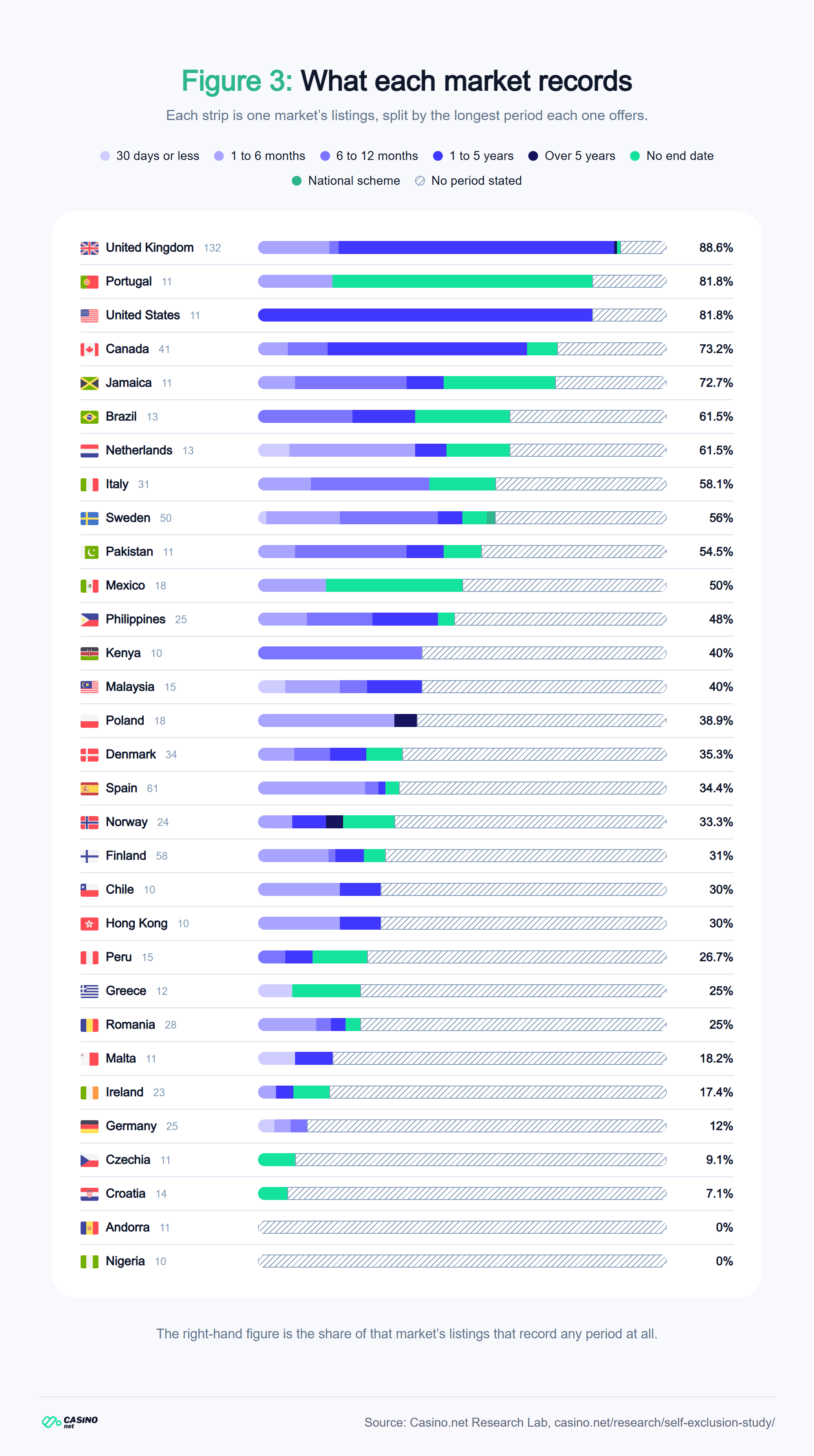
Other markets record far fewer periods. Germany states one in 3 of 25 listings, Ireland in 4 of 23, Romania in 7 of 28. Andorra and Nigeria state one in none of theirs; Croatia and Czechia in one each.
Germany does set a statutory floor. An exclusion on the national OASIS register runs for one year by default, and never less than three months. The 24-hour panic button is a separate short block.
Every market with ten or more listings
Thirty-one markets, ranked and sortable.
Figure 3: What each market records
Snapshot 5 Oct 2026Each strip is one market’s listings, split by the longest period each one offers.
United Kingdom 132 Portugal 11
 United States 11
 Canada 41
 Jamaica 11
 Brazil 13
 Netherlands 13
 Italy 31
 Sweden 50
 Pakistan 11
 Mexico 18
 Philippines 25
 Kenya 10
 Malaysia 15
 Poland 18
 Denmark 34
 Spain 61
 Norway 24
 Finland 58
 Chile 10
 Hong Kong 10
 Peru 15
 Greece 12
 Romania 28
 Malta 11
 Ireland 23Germany 25
 Czechia 11
 Croatia 14
 Andorra 11
 Nigeria 10
The right-hand figure is the share of that market’s listings that record any period at all.
| United Kingdom | 132 | 88.6% | 23 | 93 | 1 |
|---|---|---|---|---|---|
| Portugal | 11 | 81.8% | 2 | 0 | 7 |
| United States | 11 | 81.8% | 0 | 9 | 0 |
| Canada | 41 | 73.2% | 3 | 24 | 3 |
| Jamaica | 11 | 72.7% | 1 | 4 | 3 |
| Brazil | 13 | 61.5% | 0 | 5 | 3 |
| Netherlands | 13 | 61.5% | 5 | 1 | 2 |
| Italy | 31 | 58.1% | 4 | 9 | 5 |
| Sweden | 50 | 56% | 10 | 15 | 3 |
| Pakistan | 11 | 54.5% | 1 | 4 | 1 |
| Mexico | 18 | 50% | 3 | 0 | 6 |
| Philippines | 25 | 48% | 3 | 8 | 1 |
| Kenya | 10 | 40% | 0 | 4 | 0 |
| Malaysia | 15 | 40% | 3 | 3 | 0 |
| Poland | 18 | 38.9% | 6 | 1 | 0 |
| Denmark | 34 | 35.3% | 3 | 6 | 3 |
| Spain | 61 | 34.4% | 16 | 3 | 2 |
| Norway | 24 | 33.3% | 2 | 3 | 3 |
| Finland | 58 | 31% | 10 | 5 | 3 |
| Chile | 10 | 30% | 2 | 1 | 0 |
| Hong Kong | 10 | 30% | 2 | 1 | 0 |
| Peru | 15 | 26.7% | 0 | 2 | 2 |
| Greece | 12 | 25% | 1 | 0 | 2 |
| Romania | 28 | 25% | 4 | 2 | 1 |
| Malta | 11 | 18.2% | 1 | 1 | 0 |
| Ireland | 23 | 17.4% | 1 | 1 | 2 |
| Germany | 25 | 12% | 2 | 1 | 0 |
| Czechia | 11 | 9.1% | 0 | 0 | 1 |
| Croatia | 14 | 7.1% | 0 | 0 | 1 |
| Andorra | 11 | 0% | 0 | 0 | 0 |
| Nigeria | 10 | 0% | 0 | 0 | 0 |
Click any column heading to sort. Deeper shading on the third column means more of that market’s listings record a period.
The longest fixed periods recorded
Three listings in this dataset record a period longer than five years, as recorded, not re-verified.
21 years
Betclic · Poland
“From 3 months up to 21 years”
10 years
Stake · Norway
“from 6 months to 10 years”
6 years
Hippodrome · United Kingdom
“From 6 months to 6 years”
No end
64 listings
Permanent, lifetime or until revoked, as recorded
At the other end, eight listings record a break of 30 days or less. Jokerstar in Germany calls it a “24h Panic Button”. Betsson in Greece offers a 24-hour break. These are cooling-off tools filed under the same heading as exclusions that run for years, which is one reason a single recorded number is hard to compare across brands.
Deposit limits are recorded in more detail
The same database records deposit limits in far more detail than exclusions.
781
listings record a deposit limit
460
name a daily, weekly and monthly limit period
59% of deposit-limit listings
297
name no period at all
“Yes”, “Available”, “Adjustable”
117
of 128 British listings name all three
91% of British deposit-limit listings
59% of deposit-limit listings break the limit down by day, week and month, and 24 more name one or two of those periods. 45% of self-exclusion listings record a single exclusion period.
Findings, with attribution attached
Each finding copies as a full sentence with the citation. “Show the rows” filters the dataset below to the records behind it.
“More than half of online casino self-exclusion listings in the Casino.net database (493 of 903) record that the tool exists without recording how long it lasts.”
“117 of 132 British casino listings record a self-exclusion period. Only 3 of 25 German listings do.”
“Across 64 markets the longest self-exclusion period recorded is 21 years, for Betclic in Poland.”
“64 online casino listings offer self-exclusion with no end date: permanent, lifetime or until the player revokes it.”
“460 of 781 casino deposit-limit listings name a daily, weekly and monthly limit period, while only 409 of 903 self-exclusion listings record any exclusion period.”
“Eight casino listings file a break of 30 days or less under the same heading as exclusions that run for years.”
The full record
Every normalised row, with the recorded wording beside our band.
Search a brand, filter to a market, a tool or a band, then copy every match as tab-separated text straight into a spreadsheet. Re-use is free under CC BY 4.0 with attribution to Casino.net Research Lab.
United Kingdom Market
Showing 10 from 763
| Brand | Tool | Recorded wording | Band |
|---|---|---|---|
| Duelz | Deposit Limits | Daily, Weekly, Monthly | Daily, Weekly, Monthly |
| Duelz | Gambling Self-Test | Yes | Offered |
| Duelz | Loss Limits | Daily, Weekly, Monthly | Offered |
| Duelz | Protection of Minors | 18+ | Offered |
| Duelz | Reality Checks | Available | Offered |
| Duelz | Self-Exclusion | From 6 months to 5 years | 1 to 5 years |
| Duelz | Stake Limits | Available for slots | Offered |
| Duelz | Time Limits | Available | Offered |
| Duelz | Time Out | From 24 hours to 6 weeks | Offered |
| Ladbrokes | Deposit Limits | Daily, Weekly, Monthly | Daily, Weekly, Monthly |
Spain Market
Showing 10 from 313
| Brand | Tool | Recorded wording | Band |
|---|---|---|---|
| PlayUZU | Deposit Limits | yes | No period stated |
| PlayUZU | Protection of Minors | Qustodio | Offered |
| PlayUZU | Reality Checks | yes | Offered |
| PlayUZU | Self-Exclusion | Yes | No period stated |
| PlayUZU | Time Limits | yes | Offered |
| PlayUZU | Time Out | yes | Offered |
| Platincasino | Deposit Limits | Daily deposit limit: 600€, Weekly deposit limit: 1500€, Monthly deposit limit: 3000€ | Daily, Weekly, Monthly |
| Platincasino | Gambling Self-Test | yes | Offered |
| Platincasino | Protection of Minors | Pantallas amigas, Qustodio, Screentimelabs, Kids Place | Offered |
| Platincasino | Self-Exclusion | Yes | No period stated |
Sweden Market
Showing 10 from 309
| Brand | Tool | Recorded wording | Band |
|---|---|---|---|
| GoGo Casino | Deposit Limits | yes | No period stated |
| GoGo Casino | Gambling Self-Test | yes | Offered |
| GoGo Casino | Loss Limits | yes | Offered |
| GoGo Casino | Self-Exclusion | yes | No period stated |
| GoGo Casino | Stake Limits | yes | Offered |
| GoGo Casino | Time Limits | yes | Offered |
| LeoVegas | Deposit Limits | Daily, Weekly, Monthly | Daily, Weekly, Monthly |
| LeoVegas | Loss Limits | Daily, Weekly, Monthly | Offered |
| LeoVegas | Protection of Minors | Net Nanny, Cyber Sitter, GamBlock, BetBlocker, BigDeal | Offered |
| LeoVegas | Reality Checks | Yes | Offered |
Finland Market
Showing 10 from 268
| Brand | Tool | Recorded wording | Band |
|---|---|---|---|
| Spin Casino | Deposit Limits | Daily, Weekly, Monthly | Daily, Weekly, Monthly |
| Spin Casino | Gambling Self-Test | Yes | Offered |
| Spin Casino | Protection of Minors | 18+ | Offered |
| Spin Casino | Self-Exclusion | From 24 hours to 6 months | 1 to 6 months |
| Spin Casino | Time Out | Yes | Offered |
| Jellona | Protection of Minors | 18+ | Offered |
| Jellona | Self-Exclusion | Yes | No period stated |
| Rullat Casino | Protection of Minors | 18+ | Offered |
| Rullat Casino | Self-Exclusion | Yes | No period stated |
| Valtti Kasino | Deposit Limits | Daily, weekly, monthly | Daily, Weekly, Monthly |
Copying takes every matching row, not just the rows on screen.
How we built it
The method, and the six things this study cannot tell you.
The sample is every operator-market record in the Casino.net operator database carrying at least one responsible-gambling disclosure and a live trading status on 5 October 2026: 1,064 records across 540 brands and 64 markets, holding 4,228 recorded values. Records marked closed, not legal, temporarily removed or unlabelled were excluded before any counting, as were 161 rows pointing at records the database no longer returns.
Free-text values were normalised into fixed bands by documented rules. A value naming a range takes the longest period it reaches. Four of the 903 self-exclusion values, all in Spanish, fell outside the script’s rules and were banded by hand against the same rules.
- Values are database records. Each value is what the Casino.net operator database held on the snapshot date. This edition did not re-check each operator’s own page.
- A market is a database assignment. A market is the country a listing is assigned to in our database, not a licence check.
- A missing row is not a missing tool. Where we hold no record, nobody documented one. It does not establish that an operator fails to offer it.
- It is a snapshot, not a feed. Responsible-gambling pages change. Every number here describes 5 October 2026 and nothing after it.
- It is not a compliance audit. We report what the database records. We did not open accounts or test whether a stated period is honoured.
- Disclosure is not quality. A brand with a long recorded maximum is not thereby safer than one with none recorded; it is simply more legible to the player.
- Self-exclusion
- A player-initiated block that closes or restricts an account for a set period. Distinct from a time-out or cooling-off break, though several operators file both under the same heading.
- Listing
- One operator’s recorded disclosure for one tool in one market. A brand trading in six markets can carry six self-exclusion listings, and they do not always agree.
- States a period
- The recorded value names at least one duration, a range, or an explicit permanent option. “Yes” and “Available” do not qualify, and neither does a referral to a national register such as Spelpaus.
- LCCP
- The Gambling Commission’s Licence Conditions and Codes of Practice. Ordinary code 3.5.4 expects British licensees to offer self-exclusion of at least six months.
For journalists and researchers
You're welcome to use our findings in your reporting or research. Download every recorded value behind the figures: 4,228 rows across 64 markets.
- Reuse licence CC BY 4.0
- Credit Casino.net Research Lab
- Data snapshot 5 October 2026
- Questions and corrections editorial@casino.net
Our original charts and the study dataset are available under CC BY 4.0, including for commercial use. Credit Casino.net Research Lab, link to the study and the licence, and say if you have changed the material.
Example credit: Source: Casino.net Research Lab, Casino Self-Exclusion: How Long Can You Lock Yourself Out?, Edition 01. Data snapshot: 5 October 2026. Reused under CC BY 4.0.
Charts To Share
All three figures as high-resolution PNGs, branded and sourced, ready to embed with attribution.
 Figure 1: Every self-exclusion listing, placed at the longest period it offers Download PNG
 Figure 2: Compare two markets Download PNG
 Figure 3: What each market records Download PNG
Using this research
Free to reproduce, in full or in part, with attribution.